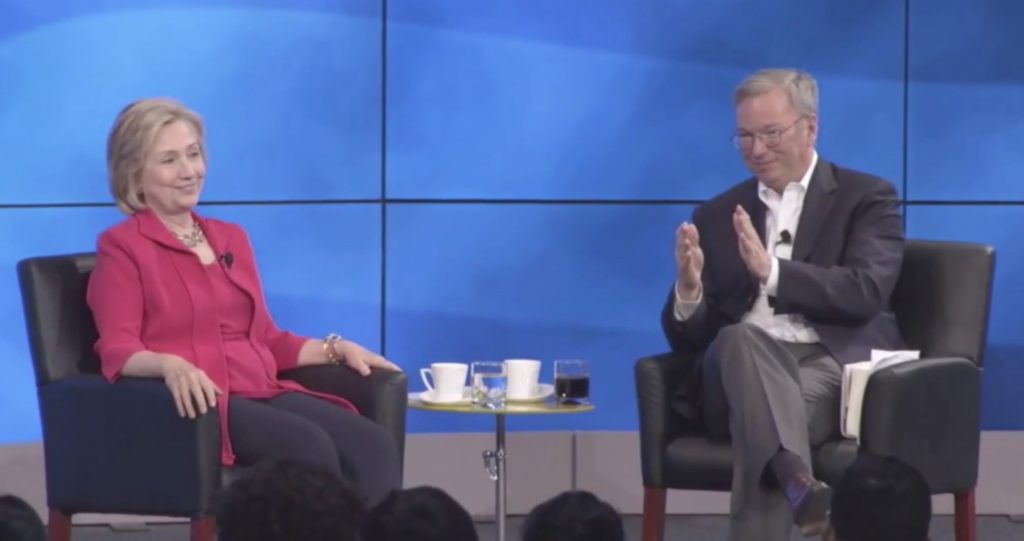
Earlier this year, when I found out Google’s Eric Schmidt had been named head of a newly created Pentagon board I thought that was creepy enough. It’s gotten creepier.
The Pentagon’s increasingly eclectic Defense Innovation Advisory Board has reached full strength, with celebrity astrophysicist Neil deGrasse Tyson and Amazon.com founder Jeffrey P. Bezos among the latest named to a group that includes some of the private sector’s most successful leaders.
Defense Secretary Ashton B. Carter established the board in March with Alphabet chairman Eric Schmidt as its head. Already, some of the members have spent time with airmen in Nevada and sailors in San Diego, and they’ll meet with other service members Tuesday at Fort Bragg, N.C., and Wednesday in Tampa, at the headquarters of U.S. Central Command and U.S. Special Operations Command, Carter said.
This would be a good time to highlight the following articles in case you missed them the first time around:
Carter spoke Tuesday in Cambridge, Mass., as the Defense Department opened an East Coast office for its Defense Innovation Unit Experimental, better known as DIUx. The first DIUx office was opened last year in Mountain View, Calif., to build new relationships between Silicon Valley start-ups and the Defense Department; the new one is expected to do the same in Massachusetts, which includes companies that have such specialties as robotics and electronic textiles.
The board now includes 15 members and is at full size. Other members named Tuesday include Jennifer Pahlka, the founder and executive director of Code for America; Milo Medin, Google’s vice president for access services, broadband and fiber network; Instagram chief executive Marne Levine; J. Michael McQuade, United Technologies’s senior vice president for science and technology. Adam Grant, an organizational psychology professor at the University of Pennsylvania’s Wharton School; Richard Murray, a bioengineering professor at the California Institute of Technology; Cass Sunstein, a legal scholar at Harvard; Danny Hillis, co-founder of Applied Inventions; and Eric Lander, the founding director of the Broad Institute of MIT and Harvard, whose focus includes biomedical and genomic research.
Naturally, Cass Sunstein caught my attention. Why you ask? This is why.
While at Harvard in 2008, Sunstein co-authored a working paper that suggests government agents or their allies “cognitively infiltrate” conspiracy theorist groups by joining ”chat rooms, online social networks or even real-space groups” and influencing the conversation.
The paper also suggests that the government “formally hire credible private parties to engage in counterspeech.” That sounds an awful lot like the 50 Cent Party of online commentators who are paid per comment by the Chinese communist party to sway public opinion.
19 ago. 2015 - Amazon workplace story by New York Times reminds us of how we are losing our hard ... nets under the windows to catch the suicides, factories belching pollution. ... Founder Jeff Bezos is the fifth wealthiest man on earth, with 188,000 .... I can buy electronic parts in San Diego, while my mom ships baby ...
4 Amazon reviews. A free inside look at ... Amazon Senior Manager, Finance Reviews ..... "Cult ofBezos: Drink the Kool-Aid and leave your humanity at the door".
2 jun. 2017 - 7 Amazon reviews. ... Salem, OR Area; – San Antonio, TX Area; – San Diego, CA Area; – San Francisco, CA Area; – San Jose, CA Area .... Amazon Chairman, President, and CEO Jeff Bezos... Sr. Management will work you to death. ... "Cult of Bezos: Drink the Kool-Aid and leave your humanity at the door".
13 abr. 2017 - I've rarely had a problem with Amazon in San Diego, but as ..... of some small stores being slowly bled to death because their margins are ... The counterfeiters are also Bezos' customers he has to show them some true customer love too /s .... to the same cargo cult so they can't hold each other accountable.
18 jun. 2017 - Amazon's latest 13.7 billion dollar acquisition of Whole Foods Corp has just positioned the ... Of course for Jeff Bezos, failure is all a part of the game and he does not have a problem ..... NBC 7 San Diego MSM Prestitute Jodi Kodesh Perpetrates Felony Perjury | Lying ... Give me liberty or give me death!
San Diego Union Tribune ^ | 5/18/2005 | Gillian Flaccus ... LOS ANGELES - A Muslim woman who said she ordered a Quran through Amazon.com only to find profanity and ... said she found profanity and the phrase "Death to all Muslims" written on the .... (PDT) by 4.1O dana super trac pak (Stop the open borders death cult).
1 ago. 2016 - US Military Adds Jeff Bezos, Cass Sunstein To Pentagon's Defense ... Neil deGrasse Tyson and Amazon.com founder Jeffrey P. Bezos among the ... San Diego, and they'll meet with other service members Tuesday at Fort ..... The only thing missing to complete the job is a dictator and thecult of the dictstor.
Wednesday, August 9, 2017
Librarians Need Not Apply>Google Hires ADL To Aid Censorship - Why Not Just Hire Islamic Brotherhood ?
Because the owners are Jewish of course and may are part of Russian Israeli mafia......
2 feb. 2015 - Librarians have been interested in the Google Books project since it began in 2004. It was a heady time to be an information worker. Google ...
In Age of Google, Librarians Get Shelved. 11 January 2016. From The Wall Street Journal: The next time you visit a public library and see an older person at the ...
Larry Page - who shares the title of Google President even has an Israeli family connection. ... Sergey Brin, co-founder of search giant Google and worth over $16bn got hitched ..... "Russian Jews lacked the vocabulary to even articulate what they were ..... By 2006, the PayPal mafia was an incestuous world where, for now, ..
While I am finding that Jewish/Zionist biographies are now being obscurred or their family ... Foundersof Google, Larry Page and Sergey Brin, own most of the shares of the company. .... He also owns theIsraeli daily newspaper Israel Hayom, and the Las Vegas Review-Journal.) .... Sergey Mikhaylovich Brin(2016/0206) ...
Feb 23, 2014 - The latest Russian American Jewish success story is truly a special one. ... Take Sergey Mikhaylovich Brin, who was born in Moscow in 1973 and moved to the U.S. to escape the persecution of Jews in Russia, and co-founded Google. ... (It's also well past time to do away with “Russian mafia” headlines and ...
Mazal Tov to Jan Koum of WhatsApp
Take Sergey Mikhaylovich Brin, who was born in Moscow in 1973 and moved to the U.S. to escape the persecution of Jews in Russia, and co-founded Google. Today, he is one of the most successful and influential people in the world. There’s actress Mila Kunis, who was born in Kiev and has been named by Esquire Magazine as the Sexiest Woman Alive. Leningrad-born Gary Shteyngart has been recognized as one of the best writers of our time. His books have won numerous awards, and his second novel was named one of the 10 Best Books of the Year by The New York Times Book Review, as well as a best book of the year by Time and The Washington Post Book World.
Entrepreneur Evgeny Freidman, the New York City taxi mogul, is an immigrant by way of St. Petersburg, and Edward Mermelstein, one of the most powerful real estate attorneys in New York is also Ukrainian-born. There’s Olympic swimmer Lenny Krayzelburg and nightclub king Eugene Remm. All of these people speak Russian as their native language – and there are so many other Russian-Americans who contribute so much to American culture, science, business, sports, and other arenas and are overlooked. (It’s also well past time to do away with “Russian mafia” headlines and related suspicions that we hear repeatedly and are a tremendously unfair stereotype.)
Russian-American Jews have had such a great impact on America – and the world. There is so much success already for them to celebrate. Let us say Mazel Tov to Jan Koum of WhatsApp. Wishing you continued success and only happiness and good things.
Ronn Torossian is not Russian, although his wife Zhanna is. He is a board member of the largest Russian-American Jewish organization, RAJE.
YouTube has over 1.5 billion monthly viewers amid a hot market for video advertising, and is likely Alphabet Inc.’s second biggest business after Google’s core internet search business. But in Alphabet’s second quarter results on Monday, the overall Google business still did not include a break-out of YouTube’s financial performance, to the detriment of investors.
Alphabet GOOGL, +0.61%GOOG, +0.80% bundles YouTube results in its overall Google properties advertising revenue, which soared nearly 20% from a year ago to $18.4 billion. Google says in regulatory filings that its “Google properties revenue” consists primarily of advertising sales generated on Google’s website and app, YouTube, and other Google-owned and -operated properties like Gmail, Google Maps and Google Play.
YouTube is clearly the star right now beyond search, however, based on the attention executives gave to the video site in Monday’s earnings call—YouTube was mentioned 25 times, according to a rough transcript of the call, challenging the word “search” (32 times) and dominating Google Play and Gmail (three times apiece) as well as Maps (seven times).
“The biggest contributors to growth again this quarter were mobile search and YouTube,” Chief Financial Officer Ruth Porat said.
Google Chief Executive Sundar Pichai, who joined Alphabet’s board Monday, also focused on the video site, discussing the 1.5 billion users and saying that they watched on average an hour a day of YouTube on phones and tablets. But that shows one of the problems in disclosing these types of metrics in conference calls with general terminology: Was that just mobile viewing? We may never know, since Google does not disclose these metrics in terms that it defines somewhere for investors to find.
In addition, new revenue-recognition rules that Alphabet has already adopted suggest that Alphabet should be disclosing YouTube results. The rules call for companies to disclose results as they are being reported to the chief decision maker, and Porat’s statements about growth suggest that there are certainly YouTube results floating around the company’s C-suite.
Seven Years Without Google in China
Alphabet’s lack of hard data behind its offerings is annoying, but it could also be detrimental to its stock. Investors may have found a reason to bid Google’s stock price higher with hard data showing YouTube’s growth Monday, but instead they seemed to focus on the falling cost-per-clicks, or CPC, metric and increasing traffic-acquisition costs, or TAC. Google’s CPC fell 23% in the quarter, compared with a drop of 7% in the same period a year ago, while TAC increased to 22% of advertising revenue from 21% a year ago, a combination that could be worrisome for Alphabet.
Beyond standard revenue and earnings, both of which beat expectations handily in Monday’s report, and some limited segmentation, that alphabet soup of acronyms are about the only metrics of consequence that Alphabet shares with the public. They seemed to have an effect Monday: Despite the earnings beat, Alphabet stock fell about 3% in after-hours trading, after gaining 13.6% in the previous three months to outperform the S&P 500 index SPX, -0.13% , which added 4% in that time.
US:GOOGL
$700$800$900$1,000$1,100
This is a company, though, that loves to be vague. Ever since it went public, Google/Alphabet has not given investors any kind of financial guidance or helpful outlook because the company’s founders, Alphabet CEO Larry Page and Sergey Brin, do not want investors to have a mentality focused on quarterly results.
So investors, without much else additional info beyond a breakout of Alphabet’s money-losing “Other Bets” segment, will continue to focus on an opaque bucket of revenue and wonky advertising metrics that would make most eyes glaze over. If Alphabet wants to celebrate its growing businesses—such as YouTube and Google Cloud—as much as executives did in Monday’s conference call, it needs to provide some real numbers in a standardized manner. It might be pleasantly surprised by the results.